
.png)



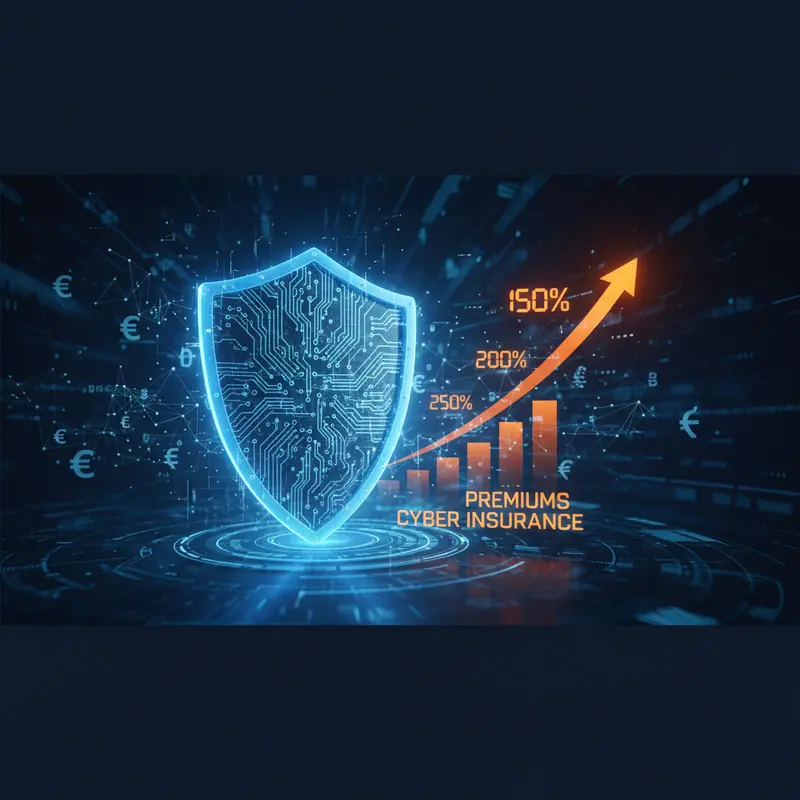
Cyber insurance premiums for fintech and crypto companies surged 38 to 52 percent year over year through 2025 according to Marsh McLennan's January 2026 Cyber Insurance Market Update, with the increases concentrated in higher-risk categories including digital asset service providers and decentralised finance protocols. The pricing dynamics reflect a combination of expanded threat landscape, increased claims frequency, and limited insurance capacity for the most challenging risk categories. The cost structure represents a meaningful operational consideration for fintech operators that has not previously been so prominent.
The headline numbers reveal the scope of premium increases. Mid-sized fintech companies with annual revenue of 50 to 500 million US dollars paid average annual cyber premiums of 380,000 dollars in early 2026, up from 248,000 dollars at the start of 2024. Crypto exchanges and digital asset service providers paid substantially more, with median annual premiums for licensed exchanges in major Asian and European jurisdictions reaching 1.4 to 4.8 million US dollars depending on transaction volumes and operational complexity. The premium escalation has materially affected fintech operating cost structures.
The driver of the premium surge has been expanded claims activity. The Federal Bureau of Investigation's Internet Crime Report for 2025 documented total reported cybercrime losses exceeding 18.4 billion US dollars, up 32 percent from 2024. Major incidents through 2025 included the SolarWinds 2.0 supply chain attack, the May 2025 social engineering attack on a major US bank that produced 280 million US dollars in customer losses, and several major ransomware incidents at financial services firms. Each major incident produced insurance claims that contributed to broader premium pressure.
The carrier market dynamics have shifted significantly. AIG, Lloyd's of London, Munich Re, and Swiss Re all reported substantially higher cyber claim ratios through 2024 and 2025, with several carriers reducing exposure to high-risk fintech categories. Some major carriers have implemented sub-limits for ransomware claims, war and terrorism exclusions for state-sponsored attacks, and stricter policy conditions including required cybersecurity controls. The combined effect is meaningfully reduced insurance capacity for fintech risks at any premium level.
Specialised cyber insurance operators have emerged to fill capacity gaps. Coalition, the technology-driven cyber insurance MGA, has grown to roughly 1.4 billion US dollars in written premium with particular focus on small and mid-sized businesses. At-Bay has similarly grown specifically targeting cyber risk in technology-focused businesses. Resilience Cyber Insurance, backed by Lloyd's syndicates, has captured share among larger fintech and financial services accounts. The specialised operators generally offer better pricing for well-protected applicants while maintaining strict cybersecurity requirements.
The required cybersecurity controls have intensified. Modern cyber insurance underwriting requires applicants to demonstrate multi-factor authentication across all systems, endpoint detection and response (EDR) tools deployment, regular penetration testing, employee security awareness training, vendor risk management programmes, and detailed incident response plans. Companies that cannot demonstrate these controls find themselves either uninsurable or facing premiums 2 to 3 times higher than well-protected peers. The control requirements have effectively forced cybersecurity investment in fintech operators that might otherwise have under-invested.
For crypto exchanges specifically, the cyber insurance market has been particularly tight. The combination of high transaction volumes, valuable digital assets requiring custody, and historical pattern of major crypto-specific cyber incidents has produced challenging insurance pricing. Several major crypto exchanges have built proprietary self-insurance funds in addition to commercial insurance to address coverage gaps, with funds typically representing 1 to 4 percent of customer assets held in segregated accounts. The combined approach addresses both the cost and capacity limitations of traditional cyber insurance for crypto businesses.
DeFi protocol coverage remains the most challenging segment. Traditional cyber insurance policies generally exclude smart contract bugs and DeFi protocol exploits from coverage, leaving DeFi protocols largely self-insured for these risks. Specialised DeFi insurance protocols including Nexus Mutual, InsurAce, and Sherlock have emerged to fill this gap, with combined coverage capacity of approximately 480 million US dollars across the major DeFi insurance protocols. The coverage is meaningful but limited compared to actual DeFi total value locked in the trillions of dollars.
Claims handling has been a significant pain point. Cyber insurance claims involve complex forensic investigations to determine actual losses, attack vectors, and policy coverage applicability. Major claims often take 6 to 18 months to resolve, with substantial costs in legal and forensic services that may not be fully covered. Fintech operators that experienced major incidents have generally reported challenging claim experiences even when coverage was eventually paid. The pattern has reinforced the value of strong cybersecurity prevention rather than relying primarily on insurance for risk management.
Regulatory pressure has shaped cyber insurance market dynamics. The SEC's December 2023 cybersecurity disclosure rules, the EU's NIS2 Directive in force through 2024 and 2025, and various state-level regulations have all created legal incentives for fintech operators to maintain adequate cyber insurance coverage. The combined regulatory pressure has supported insurance demand even as premiums have increased substantially.
International market dynamics have produced regional pricing differences. UK-based fintech operators generally pay 15 to 25 percent more than comparable US operators due to UK-specific regulatory requirements and Lloyd's market conditions. Asia Pacific fintech operators in major hubs like Singapore and Hong Kong typically pay 20 to 35 percent less than comparable US operators, reflecting different claims environments and broader insurance market dynamics. The pricing differentials matter for fintech operators evaluating where to domicile operations.
The competitive implications for fintech operators have been meaningful. Companies with strong cybersecurity infrastructure, demonstrated incident response capabilities, and ongoing security investments capture meaningful insurance pricing advantages. The advantages compound, since better-insured operators can offer customers better security guarantees, attract better partnerships, and pursue more aggressive growth strategies without disproportionate cyber risk. Smaller operators struggling with cyber insurance have faced existential pressure to either invest heavily in security or exit the market.
For investors and partners evaluating fintech operators, cyber insurance maturity has emerged as a meaningful diligence dimension. Companies with strong insurance positioning and reasonable premium costs typically reflect mature operational risk management. Companies struggling with cyber insurance availability or pricing usually reveal underlying operational risk concerns that warrant scrutiny. The cyber insurance lens provides useful evaluation signal alongside traditional financial and operational analysis.
Looking ahead through 2026 and 2027, cyber insurance premiums are likely to continue increasing as cyber threats evolve and claims experience matures. The industry is likely to continue consolidating around well-capitalised carriers and specialised technology-focused operators, with smaller carriers exiting cyber insurance entirely. The relationship between cybersecurity investment and insurance affordability will continue tightening, making prevention substantially more important than insurance recovery for fintech operators that want manageable cost structures and operational resilience.


